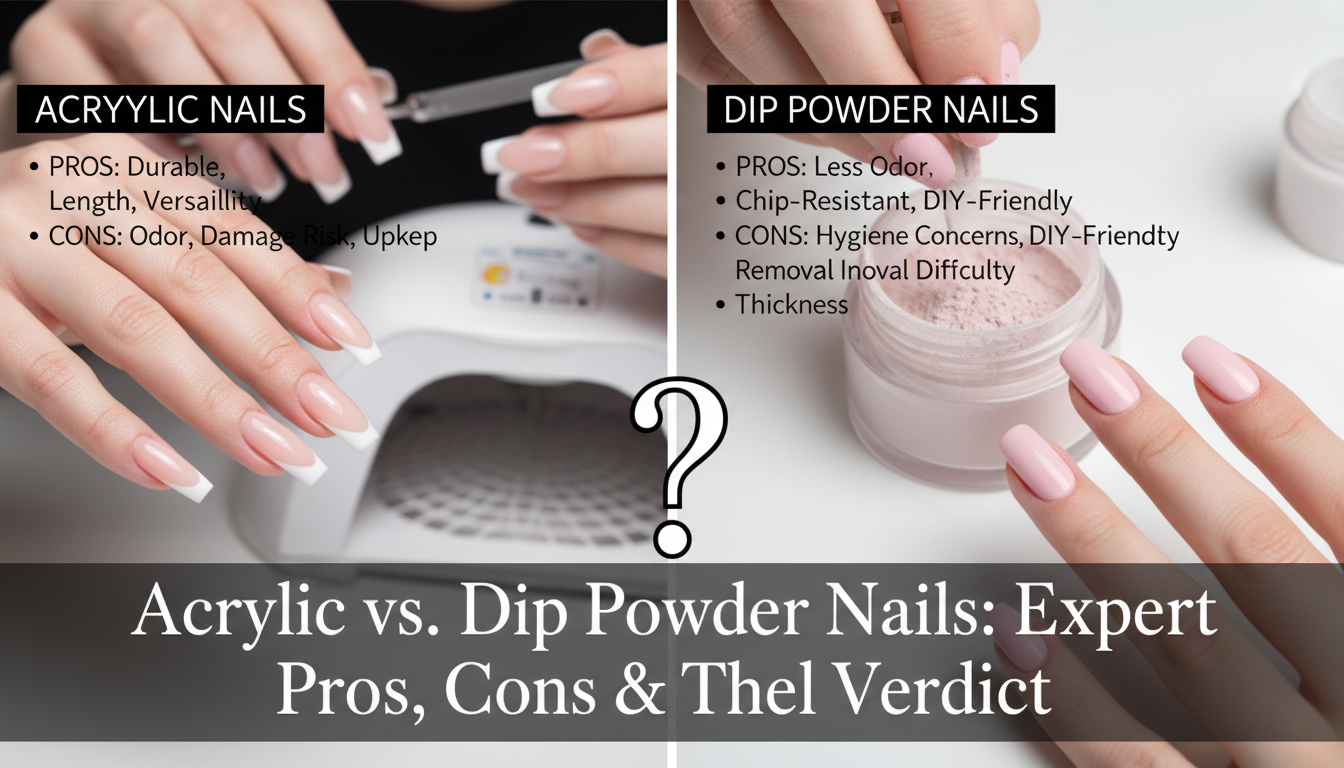
Choosing between acrylics and dip powder can feel like a high-stakes beauty gamble. Both offer the promise of long, chip-free manicures that look significantly more polished than standard polish. However, despite their similar appearances, the chemical compositions, application methods, and long-term effects on your natural nails vary significantly.
As a seasoned nail professional will tell you, there is no “one size fits all” answer. The right choice depends on your lifestyle, the health of your natural nail bed, and your aesthetic goals. In this guide, we will break down the technical differences and practical realities of both systems to help you make an informed decision at your next salon visit.
Understanding the Basics: What Are They?
Before diving into the comparison, it is essential to understand that both acrylics and dip powder technically belong to the same chemical family. They both utilize acrylic polymers to create a hard protective layer over the nail. The difference lies in the bonding agent and the application technique.
What are Acrylic Nails?
Acrylic nails are the “OG” of the nail world. They involve mixing a liquid monomer and a powder polymer. When the technician dips their brush into the liquid and then the powder, a chemical reaction creates a malleable bead of “plastic.” This bead is sculpted onto the nail and air-dries into a hard, durable surface. Because they are sculpted, acrylics are the gold standard for adding significant length or creating complex shapes like stiletto or coffin nails.
What is Dip Powder?
Often referred to by the brand name SNS, dip powder is essentially a “glue-based” acrylic system. Instead of a liquid monomer, it uses a resin (typically cyanoacrylate, the main ingredient in super glue). The technician applies a base coat, dips your finger into a jar of pigmented powder, and repeats the process until the desired thickness is achieved. An “activator” is then applied to cure and harden the layers.
The Application Process: What to Expect
The experience in the salon chair differs quite a bit between the two methods, especially regarding time and technique.
- Acrylic Application: This is a highly skilled craft. Your technician must balance the liquid-to-powder ratio perfectly. It often involves a stronger odor due to the evaporation of the monomer. It is generally a longer process because of the precision required in sculpting.
- Dip Powder Application: This is generally faster and more “idiot-proof.” There are no harsh chemical odors because no liquid monomer is used. However, there are sanitary concerns to watch for; a reputable salon should pour the powder over your nail or use individual portions rather than having multiple clients dip their fingers into the same jar.
Acrylic vs. Dip Powder: Side-by-Side Comparison
To help you visualize the differences, here is a breakdown of how these two popular services stack up against each other:
| Feature | Acrylic Nails | Dip Powder Nails |
|---|---|---|
| Durability | Extremely hard; best for heavy-handed users. | Very durable but more flexible than acrylic. |
| Flexibility | Rigid; can crack under extreme pressure. | More flexible; less likely to “snap.” |
| Thickness | Usually thicker and more “artificial” looking. | Thinner and more natural. |
| Odor | Strong chemical scent during application. | Odourless. |
| Drying/Curing | Air-dries (No UV light needed). | Uses an activator (No UV light needed). |
| Longevity | 2–3 weeks (Requires fills). | 3–4 weeks (Usually requires full soak-off). |
Health and Safety: Which Is Better for Your Nails?
A common misconception is that dip powder is “organic” or “natural.” While it is often marketed this way, it is still a chemical enhancement. However, there are health trade-offs for each.
The UV Factor
Both acrylic and dip powder are great alternatives for those who want to avoid UV exposure, as neither requires a UV lamp to cure (unlike gel polish). This is a major selling point for clients concerned about skin health on their hands.
Nail Bed Damage
The damage usually doesn’t come from the product itself, but from the removal process and the prep work. Acrylics often require more “roughing up” of the natural nail with an e-file to ensure the product sticks. Dip powder, being thinner, requires slightly less aggressive buffing. However, because dip powder is bonded with resin, it can be incredibly stubborn to remove, leading some users to pick at it—which causes significant trauma to the nail plate.
Pros & Cons
Pros of Acrylic Nails
- Infinite Customization: Can be used to create extreme length and 3D art.
- Structural Integrity: Best for repairing broken nails or extending very short, bitten nails.
- Lower Cost: Generally the most affordable long-wear option in salons.
- Fills: You don’t have to remove the whole set; you can simply “fill” the regrowth every few weeks.
Cons of Acrylic Nails
- The Smell: The fumes can be overwhelming for sensitive individuals.
- Rigidity: If you jam your finger, the acrylic is so hard it might take your natural nail with it when it breaks.
- Professional Skill Required: A bad acrylic job looks bulky and “fake.”
Pros of Dip Powder Nails
- Natural Look: Provides a thinner, more refined finish that mimics a natural nail.
- Durability: Often lasts longer than acrylic without lifting.
- Speed: Generally faster to apply than a full set of sculpted acrylics.
- No Fumes: A much more pleasant sensory experience in the salon.
Cons of Dip Powder Nails
- Hygiene Risks: “Double-dipping” in communal jars can spread nail fungus or bacteria.
- Removal: Requires a long soak in acetone, which can dry out the surrounding skin.
- Weight: Can feel heavy on the nails if too many layers are applied.
The Final Verdict: Which Should You Choose?
After weighing the expertise of nail technicians and the practicalities of daily wear, the winner depends on your specific goals.
Choose Acrylic Nails if: You want dramatic length (extensions), you enjoy complex 3D nail art, or you are looking for a cost-effective solution that you can maintain with “fills” for months at a time.
Choose Dip Powder if: You prefer a natural-looking manicure on your own nail length, you have a sensitive nose, or you want a DIY-friendly option that stays chip-free for nearly a month. It is the superior choice for those who value a “thin but strong” aesthetic.
Frequently Asked Questions
Is dip powder really better for your nails than acrylic?
Not necessarily. While dip powder doesn’t require as much filing of the nail surface, the resin (glue) used is very strong and requires a long acetone soak for removal. Both can be damaging if not removed professionally. The “healthiness” of a manicure depends more on the technician’s skill than the product used.
Can you do a “fill” on dip powder?
Technically, yes, but most technicians advise against it. Because dip powder is applied in layers, a fill can look bulky and uneven. Most professionals recommend a full soak-off and a fresh application for dip powder to maintain hygiene and a clean look.
How long does each one take to apply?
A full set of acrylics typically takes 60 to 90 minutes, depending on the complexity of the shape and art. Dip powder is usually faster, taking about 45 to 60 minutes.
Does dip powder ruin your nails?
Dip powder itself doesn’t ruin nails, but improper removal does. If you peel or e-file the dip powder off, you will remove layers of your natural nail, making them thin and brittle. Always soak them off in pure acetone.
Which is more expensive?
In most regions, dip powder is slightly more expensive than a standard set of acrylics. However, because dip powder often lasts longer without lifting, the cost-per-week of wear is very similar.
—
Topic: Acrylic nails vs Dip powder pros and cons
Tags: #Acrylic #Dip #Powder #Nails #Expert #Pros #Cons #Final #Verdict