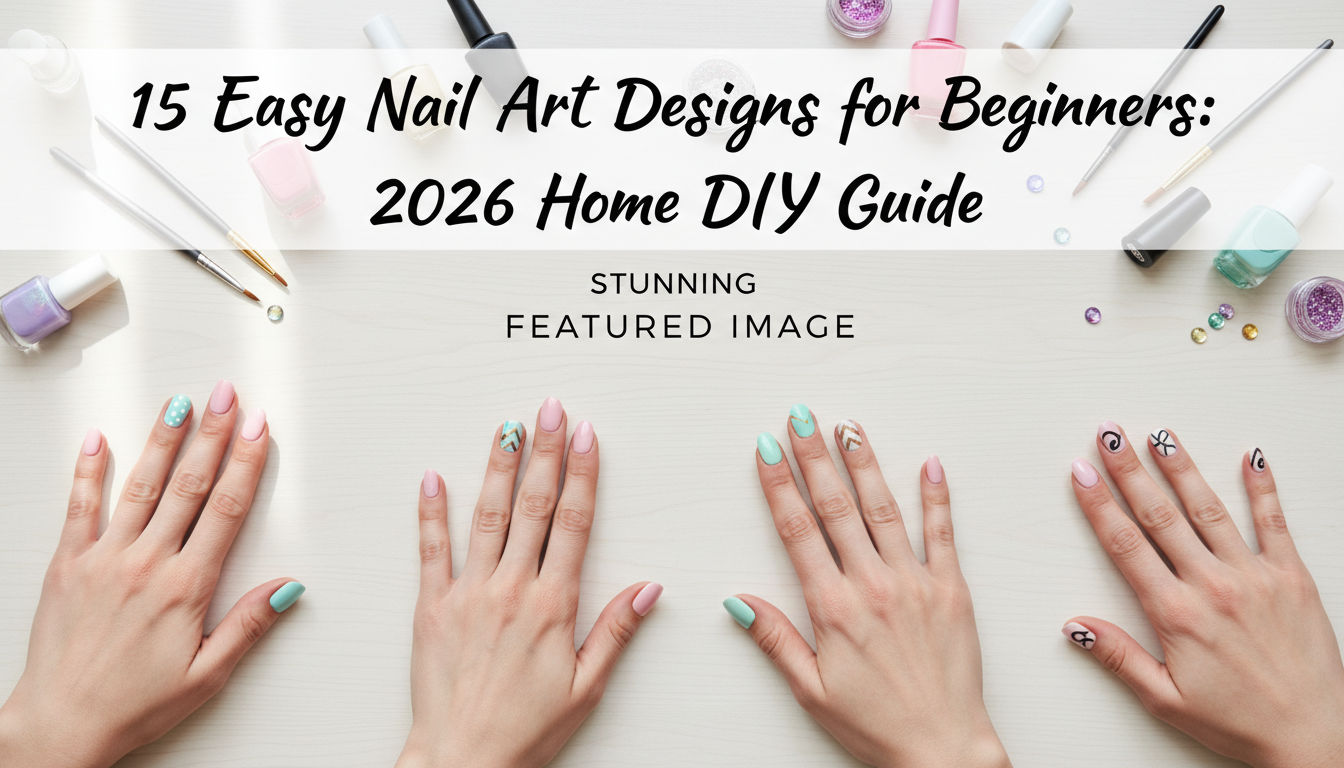
Transforming your nails into a canvas of self-expression doesn’t require a professional license or a suitcase full of expensive equipment. As we move into 2026, the trend in manicures has shifted from overly complex, time-consuming salon visits to “elevated simplicity”—designs that look high-end but can be achieved on your coffee table in under thirty minutes.
Whether you are a total novice or someone looking to refine your home DIY skills, these 15 designs prioritize ease of application without sacrificing style. By focusing on fundamental techniques like dotting, sponging, and negative space, you can achieve a professional-grade finish that lasts.


The Essential DIY Nail Art Toolkit for 2026
Before diving into the designs, ensure you have these basic supplies. Most “pro” looks are actually just clever uses of household items or affordable tools.
- Base and Top Coat: Essential for protecting the natural nail and sealing the design for longevity.
- Dotting Tools: If you don’t have these, a bobby pin or a toothpick works perfectly.
- Makeup Sponges: Used for creating gradients and ombré effects.
- Striping Tape or Washi Tape: For clean, crisp geometric lines.
- Clean-up Brush: A small, flat synthetic brush dipped in acetone to tidy up the edges.
15 Stunning and Easy Designs for Beginners
1. The Micro-French Tip
The traditional chunky French tip has been replaced by the “Micro-French.” This involves a paper-thin line at the very edge of the nail. For 2026, try using unconventional colors like neon green or chrome silver instead of white. The easiest way to achieve this is by using a silicone nail stamper—apply polish to the stamper and gently press your nail tip into it.
2. Minimalist Polka Dots
Simple dots are the foundation of nail art. For a modern look, place a single, high-contrast dot (like black on a nude base) near the cuticle of each nail. Use the round end of a bobby pin for perfectly circular shapes every time.
3. Gradient Ombré (The Sponge Method)
Select two or three colors in the same family—for example, soft lavender, violet, and deep plum. Apply stripes of these colors onto a makeup sponge and dab it onto your nail. The sponge blends the colors naturally, creating a sunset effect that hides imperfections well.
4. Negative Space Half-Moons
Negative space designs utilize your natural nail as part of the art. Place a circular reinforcement sticker (the kind used for loose-leaf paper) at the base of your nail. Paint over the rest of the nail and peel the sticker away while the polish is still slightly tacky to reveal a clean “moon” at the base.
5. Cloud Nails
Cloud art looks dreamy but is incredibly forgiving. Using a light blue base, take a white polish and use a dotting tool to create three overlapping circles of different sizes. Gently swirl the edges while wet to create a fluffy, organic cloud shape.
6. Abstract “Blob” Art
Abstract art is perfect for beginners because there is no such thing as a mistake. Pick three complementary colors and drop small, irregular “blobs” of polish onto the nail. Use a toothpick to lightly swirl them together or leave them as distinct shapes for a 1990s retro vibe.
7. Geometric Lines with Tape
If you can’t draw a straight line, let tape do it for you. Apply a base color and let it dry 100%. Place thin strips of tape in a “V” shape or across the nail, paint over them with a second color, and remove the tape immediately. This creates sharp, professional-looking geometric barriers.
8. The “Skittles” Manicure
This is the ultimate low-effort, high-impact design. Simply paint each nail a different shade within the same color story (e.g., five different shades of green). It requires no “art” skills, just a good eye for color coordination.
9. Dainty Daisies
To create a flower, place five dots in a circle using your dotting tool. Once dry, place a single dot of a different color (usually yellow or gold) in the center. This is a timeless spring look that takes less than five minutes per hand.
10. Marble Swirl (Dry Method)
Instead of the messy water-marble technique, try the dry method. Place three or four drops of different colored polishes on the nail while the base is still wet. Use a toothpick to drag the colors through each other in a figure-eight motion until you reach a marble-like consistency.
11. Metallic Foil Accents
Nail foils are incredibly beginner-friendly. Apply a base color, let it get “tacky” (almost dry), and then press a piece of metallic nail foil onto random spots. The foil only sticks to the tacky areas, creating an expensive-looking distressed gold or silver leaf effect.
12. The “Glazed Donut” 2.0
Popularized in recent years and evolving into 2026, this look involves a sheer milky base topped with a pearlescent “chrome” powder or a shimmer top coat. It mimics the look of a glazed pastry and hides nail ridges or unevenness effectively.
13. Vertical Stripe Elongation
A single vertical line running down the center of each nail can make short nails look significantly longer. Use a long-bristled “striper” brush or even a sharpened toothpick to draw one steady line from the cuticle to the tip.
14. Cow Print (Organic Beauty Shapes)
Animal prints are surprisingly easy because they are meant to be irregular. On a white base, use a black polish to create random, “blobby” shapes. Because cow spots aren’t uniform, you don’t need a steady hand to make this look great.
15. Tiny Heart Accents
Creating a heart is easier than you think. Place two dots side-by-side with a dotting tool. Use a toothpick to drag the bottom of each dot downward to a center point, forming a “V” shape that completes the heart.
Comparison of DIY Techniques
| Technique | Difficulty (1-5) | Key Tool | Best For |
|---|---|---|---|
| Dotting | 1 | Bobby Pin/Dotter | Florals, Polka Dots |
| Sponging | 2 | Makeup Sponge | Gradients, Textures |
| Taping | 3 | Washi Tape | Sharp Geometrics |
| Freehand Swirls | 2 | Toothpick | Marbling, Abstract |
Pros and Cons of Home DIY Nail Art
Pros
- Cost Efficiency: A single salon visit can cost more than a full kit of 10+ polishes and tools.
- Creative Freedom: You can change your design as often as you like without making an appointment.
- Nail Health: Doing it yourself allows you to control the quality of products, opting for “10-free” or non-toxic polishes.
Cons
- Learning Curve: Your non-dominant hand will take practice to master.
- Time Investment: Initial attempts may take longer than a professional service.
- Durability: Without professional-grade curing lamps, DIY polish may chip faster than salon gels.
Expert Tips for Long-Lasting DIY Results
To ensure your hard work doesn’t chip within 24 hours, follow these three golden rules of home manicures:
- Prep is Paramount: Dehydrate the nail plate before painting. Use a cotton ball with a bit of rubbing alcohol or acetone to remove natural oils. This helps the polish bond to the nail.
- Cap the Edges: When applying your top coat, run the brush along the very edge (the free edge) of your nail. This “caps” the polish and prevents it from lifting at the tips.
- Thin Layers: It is always better to apply three paper-thin layers than one thick layer. Thick layers trap moisture and lead to bubbling and peeling.
Frequently Asked Questions
How can I make my nail art look professional as a beginner?
The “secret” to a professional look is clean-up. Use a small brush dipped in nail polish remover to wipe away any polish that touched your skin or cuticles. A clean border makes even simple designs look high-end.
What is the best way to fix a smudge?
If you smudge a design while it’s wet, don’t start over. Dip your finger in a bit of saliva (the enzymes help smooth the polish) or a drop of cuticle oil and gently rub the smudge to flatten it. Then, apply a fresh layer of top coat to hide the texture.
How long should I wait between layers?
In 2026, modern polish formulas dry faster, but you should still wait about 2 to 3 minutes between coats. For the final top coat, wait at least 5 minutes before doing any light activity, and 30 minutes before anything strenuous.
Do I need a UV light for these designs?
No. These designs are intended for regular air-dry nail polish. However, if you prefer gel, you can use the same techniques and simply cure under a lamp between each step.
—
Topic: Easy nail art designs for beginners at home 2026
Tags: #Stunning #Easy #Nail #Art #Designs #Beginners #Home #DIY #Guide